Crop-Vu
The Future of Crop Management, today
Crop-Vu
Crop-Vu Home About Crop-Vu Products & Services Research & Development Contact Us
Crop-Vu Research & Development
 
Crop-Vu
Crop-Vu - The Future of Crop Management, today
Crop-Vu Research & Development

Crop-Vu Research & Development

Thermal Crop Water Stress Indices:
We are pursuing the development and validation of a new method for detecting crop water stress remotely through the measurement of the crop's canopy leaf surface temperature. The correlation between leaf surface temperature and water stress is based on the assumption that as a crop transpires, the evaporated water cools the leaves. As the crop becomes water stressed, transpiration will decrease, and thus the leaf temperature will increase.

Other factors need to be accounted for in order to get a good measure of actual stress levels, but leaf temperature is one of the most important. We believe that Canopy Thermography (the thermal characterization and assessment of the canopy leaves) offers a new tool for managing canopy and water input for the production of quality turf grass fruit and good yield.

Our rationale, rooted in the work initiated by Jackson in 1982, is that the plant can viewed as the integrator of the soil-water-plant relationship and the canopy temperature is the indicator of water stress. Then by using a Biologically Identified Thermal Interactive Console (BIOTIC) approach (Upchurch et al., 1996) one can monitor the accumulation of stress by observing the canopy temperature. We also know that in an isohydric plant, canopy temperature can be used to indicate the need for irrigation by assessing the amount of time that the temperature exceeds a crop specific temperature threshold (D. F. Wanjura et al., 2004).

Thus in a healthy isohydric crop it should be possible to measure the canopy temperatures across the full extent of the field by applying far-infrared imagery and then, by establishing a relationship between the relative canopy temperatures and a crop specific temperature or temperature range, guide the application of irrigation to mitigate the plant stress.

Theranl Regulation In Isohydric Plants

We know that canopies intercept some of the energy in sunlight so that chlorophyll can produce sugars and other organic compounds from carbon dioxide and the input water. The canopy is also important in cooling the plant by three different means; scattering, transpiration, and shade, so that it does not overheat or cook in the sun. (See Managing the Thermal Character of the Canopy)

Thus the relationship of photosynthesis and water input can be seen in the canopy temperature and although plants don’t regulate their temperature the degree of temperature control afforded by scattering, shade, and transpiration is critical to the plant’s health and to the quality and yield of the product.

Our research is focused on exploiting the potential for using a map of canopy temperatures derived from in-field/ground based thermal (far-infrared) imaging to identify plant water stress, monitor plant water status, and to facilitate efficient application of irrigation. Based from these findings we will establish the imaging protocols and algorithms to provide irrigation guidance and an ‘irrigate-now’ index from the thermal imagery.

The goal of our research is to establish the protocols and algorithms that can be easily applied to turf grass, vine and tree fruit, and farm grown vegetables, and to facilitate the development of an affordable and simple to operate thermal remote sensing system to do the job.

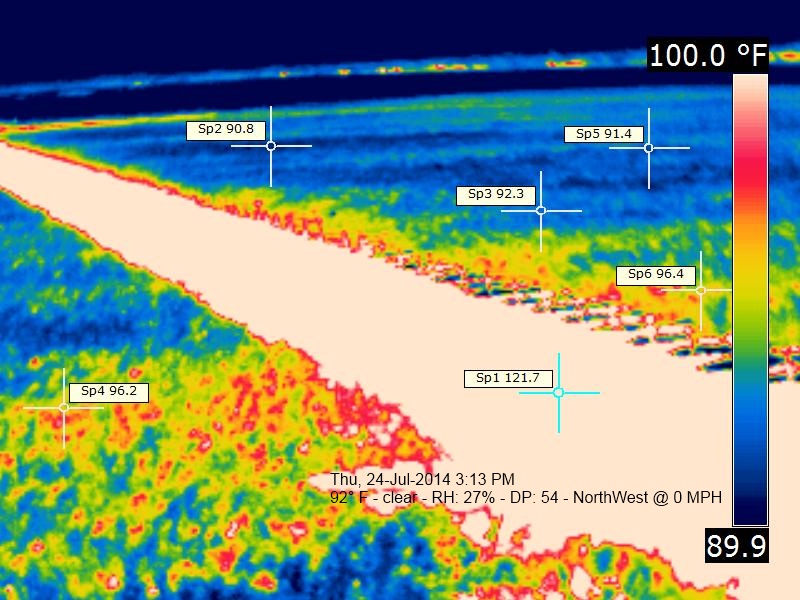
Pictured below is a thermal image of a cotton canopy that was part of an USDA ARS water and nitrogen study in Arizona. Blues and greens represent lower temperatures than yellow and orange. The image was acquired with a far-IR thermal scanner on board a helicopter. Most of the blue rectangles (plots) in the image correspond to high water treatments. However, note that many of the patterns do not correspond to the treatment plots, but represent the natural variability in soil conditions across the field.

Thermal Crop Water Stress
View Entire PDF Report On Thermal Crop Water Stress Indices

If the field above were irrigated uniformly, some areas of the field would receive more water than the plants need, while other areas would not receive enough. Therefore, varying the application across the field could reduce water use without significant impact on crop yield.
 
 
Crop-Vu is a division of ItriCorp

Crop-Vu Home  |  Products & Services  |  Research & Development  |  About Crop-Vu  |  Contact Us

© Copyright 2011 Crop-Vu  -  All Rights Reserved | Crop-Vu is a division of ItriCorp